21.5.11
Invaluable reward gained as a dutiful teacher
Preparation of lecture note is a learning process for the instructor even if he / she have already knew the subject matter for many years. Personally I took the preparation of lecture process a re-learning opportunity to gain new insight on the physics and mathematics already known or unknown to me. Say for example, I know nothing except by name the term “vector space”, “basis set” in linear algebra, or “grand canonical ensemble”, “chemical potential” in statistical mechanics. Now, after lectured to an audience of ~ 100 students in the linear algebra and statistical mechanics classes, I claimed to have understood these things quite well, despite my knowledge on these topics were effectively zero before undergoing the painstaking lecture preparation process. I used to tell my statistical mechanics class that in terms of knowledge gained, I was the person who has benefited the most from my own lectures. Incidentally the knowledge I taught to the statistical mechanics and calculus and linear algebra classes turned out to be very useful later when I embarked on my research topics in computational condensed matter physics. Hence it aroused in me the realisation: the eventual usefulness derived from the teaching process is indeed an invaluable reward to those who bothers to take teaching seriously and dutifully.


My lecture notes
For the undergraduate physics theory courses I taught, the most complete reference source should be the text books. However, the sad “tradition” in USM is, many students rely only on lecture notes and never read the text books. Lecture notes are a tool I used to assist my lectures. Their content usually was narrated based on existing textbook materials with additional modification and improvisation by me. Well aware of the habitual trend of students to rely heavily on lecture notes for scoring exam, I warned against being too dependent on the lecture notes. At best my lecture note only serves as a summary of the subject matter, in addition to being a material projected on the screen used for lecturing purpose. I took serious effort to make the lecture note to at least fulfil my own criteria. For example, I would never want to put in any statement I myself did not understand. The set of lecture notes forever undergo a constant process of evolution, correction, modification for improved quality. Usually a complete set of lecture notes for a course could cost me up to effectively 200 hours or more. It is also not uncommon that I made major modification to the existing lecture notes, or even a re-write. This happened for example in the first few years when I first taught the Calculus and Linear Algebra course ZCA 110, where I had written four effectively new set of lecture notes until they settled into a stable version.
As I have come to realise it after many years of observation, physics classes are almost inevitably dry, boring and sometimes, scary. In terms of physics analogy, it has unusually high thermal fluctuation that tends to disperse then to coagulate. Personally, my core belief is that physics is not a dry or boring subject. It is intellectually lively, interesting, and relevant to the real world. It is thus always possible to make a physics teaching process fun and interesting, if one bothers to do it. The actual presentation during the real lecture is of course the single most important criterion that determines whether a physics lecture is boring or interesting. On the other hand, quality of the lecture notes also affects quite directly the quality of a lecture in progress. As a matter of personal policy I always try to factor in two important elements. First there must be as much “fun” elements as possible into the lecture materials. Second, the course material should prompt the students to see distinctly the relevance between the theory they learn and the real world they are dwelling in. To achieve such effects, I adopted the strategy as proposed by Tony Buzan, the creator of mind mapping to attract our mind’s attention. According to Buzan, our mind gets attracted most easily to colourful and graphical objects, as well as objects that provide ample space for imagination. To this end, my lecture material are packed with graphics, cartoons, animation, questions that arouse curiosity, comics, physicists’ bibliography, poems, literature quotes, history and philosophy of physics, and other content that is surprisingly unexpected for a physics lecture note. As an example, I would use the movie Lord of the Ring: The Two Towers to illustrate the concept of simultaneity in my special relativistic class. See figure 1.
 Figure 1: The two towers as appeared in the movie “The Lord of the Ring” were used in a scenario to illustrate the concept of simultaneity in the special relativity class.
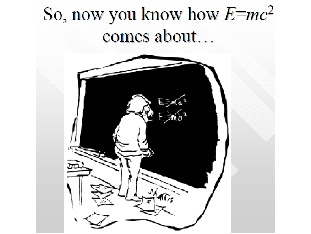 Figure 2: A comic that makes fun of the equation E = mc2. The appearance of the humour in a typically boring physics lecture note adds a pinch of human touch to the learning process.
Figure 2 is a slide from my modern physics ZCT 104 notes, in which I slot in a funny cartoon to poke joke on the famous equation E = mc^2.
 Figure 3: The bibliography of Heisenberg, one of the fathers of quantum mechanics, as appeared in the ZCT 104 lecture material. Students learn some physics history in addition to the uncertainty equation.
Figure 3, also a slide taken from the modern physics lecture note, mention the controversial role played by the physicist Warner Heisenberg during World War II in the Nazi camp. I would usually tell interesting stories and inferences derived from these figures in the lecture hall when they appear on the screen. This story-telling part is what the students like best in during a lecture.
 Figure 4. A suspense-creating question was asked in the beginning of the topic. It would get resolved only towards the end of the lecture after the students realised what time dilation and length contraction, as predicted by special theory of relativity, really meant.
Figure 4 is a “classic” slide from my modern physics course designed to prompt some suspense to the audience, “Can one travels through a distance of 200 light years within one’s life time?” The students would be kept in a suspense mode until the end of the topic when they fully comprehend the idea of time dilation and length contraction as predicted in special theory of relativity.
As I have come to realise it after many years of observation, physics classes are almost inevitably dry, boring and sometimes, scary. In terms of physics analogy, it has unusually high thermal fluctuation that tends to disperse then to coagulate. Personally, my core belief is that physics is not a dry or boring subject. It is intellectually lively, interesting, and relevant to the real world. It is thus always possible to make a physics teaching process fun and interesting, if one bothers to do it. The actual presentation during the real lecture is of course the single most important criterion that determines whether a physics lecture is boring or interesting. On the other hand, quality of the lecture notes also affects quite directly the quality of a lecture in progress. As a matter of personal policy I always try to factor in two important elements. First there must be as much “fun” elements as possible into the lecture materials. Second, the course material should prompt the students to see distinctly the relevance between the theory they learn and the real world they are dwelling in. To achieve such effects, I adopted the strategy as proposed by Tony Buzan, the creator of mind mapping to attract our mind’s attention. According to Buzan, our mind gets attracted most easily to colourful and graphical objects, as well as objects that provide ample space for imagination. To this end, my lecture material are packed with graphics, cartoons, animation, questions that arouse curiosity, comics, physicists’ bibliography, poems, literature quotes, history and philosophy of physics, and other content that is surprisingly unexpected for a physics lecture note. As an example, I would use the movie Lord of the Ring: The Two Towers to illustrate the concept of simultaneity in my special relativistic class. See figure 1.


Figure 2 is a slide from my modern physics ZCT 104 notes, in which I slot in a funny cartoon to poke joke on the famous equation E = mc^2.

Figure 3, also a slide taken from the modern physics lecture note, mention the controversial role played by the physicist Warner Heisenberg during World War II in the Nazi camp. I would usually tell interesting stories and inferences derived from these figures in the lecture hall when they appear on the screen. This story-telling part is what the students like best in during a lecture.

Figure 4 is a “classic” slide from my modern physics course designed to prompt some suspense to the audience, “Can one travels through a distance of 200 light years within one’s life time?” The students would be kept in a suspense mode until the end of the topic when they fully comprehend the idea of time dilation and length contraction as predicted in special theory of relativity.
The style of my exam questions
As an unhealthy tradition, students like to memorise formula, facts and solutions of past year questions when they go into the exam halls. How would you make them not to do so in your paper? First, you don’t’ recycle your past year questions. Second, design questions that genuinely test the level of their understanding. To put this into practice, in most of my final exam questions for the first year students, I would include a multiple choice question section, which contained between 20 – 40 questions. It is comprised of non-calculative questions that can be answered without a calculator, designed with the intention to test the level of understanding on the theoretical aspects of certain specific physics concepts. This section is “notorious” among the students because one will have very little chance to pick the correct option without having any in-depth knowledge and logical thinking of the particular concept being tested. In addition, these questions were never recycled, hence you can’t answer the questions correctly by only memorising the past year questions. All of the answers and occasionally the full solution to these multiple choice questions would also be uploaded online. On top of these, the solution scheme may also indicate the source where these questions were adapted or inspired. A large percentage of these objective questions were original. After a few years of teaching Modern Physics ZCT 104 for example, a large body of objectives questions have been accumulated. Students were advised to go through them as an effective way to deepen their understanding on a particular topic. The solutions were themselves valuable examples to illustrate the application of the physics concepts taught in the course. When I designed these exam questions I bear in mind that these question sets would be made as a source of knowledge for the students in the future. Understandable, preparing these multiple-choice questions demands quite a bit of thinking effort. To make matter worse, these questions were also required to be translated into Bahasa Malaysia, which often meant another whole-day work for me.
Experimenting the best way to assess the coursework
Other than giving short quizzes and test, throughout the years I have also tried to devise various not-so-conventional ways to assess the students as a continuous effort to optimise the quality of the assessment. Below are some examples of my attempts.
Open book quiz was administered right after the lecture on a chapter is completed. Usually open book quiz means the solutions are not directly available in the text book. Open book quiz free students from the almost compulsory practice of rote memorisation. On the other hand, despite having the textbook available for reference, students found themselves being challenged very hard in these quizzes, and were forced to think harder. However, this attempt did not work very well. Except a few students who could think out the box, most students who were average in their learning and thinking model failed to answer well these challenging questions. The overall coursework grade for the class was so poor that I never give open book quiz again in other classes.
The “Sample Questions by Students” initiative: Students were invited to design some samples of formatted objective questions based on the topics covered in the course. These objective questions were required certain criteria, especially, they must be original (no cut-and-paste from existing resources), conceptually correct, creative, and “interesting”. Copy cat or boring questions were filtered and rejected. Once accepted, the designer of the questions would be given bonus points for the coursework. The accepted “designed questions” were edited or corrected by me, and then stored in a question bank which, like all other course-related material, was accessible online. I also promised the students to adopt some of the selected designed questions in the examination as an incentive. This initiative promoted a good sense of participation in the teaching and learning process. In addition, to design an original objective question demands thorough knowledge about the subject matter. Creating sensible questions to someone deepen the level of understanding on a particular concept in the questioner, a wonderful and interesting way to make a student become learned. A student who attempted to design a question inevitably must also get involved in an in-depth learning process. Overall, in that attempt 143 designed questions were received. Not every ones found this initiative inviting, only about less than 20% students sent in their questions, of which many are copy-cat. But those who are enthusiastic found the initiative an interesting learning experience. One thing for sure, the initiative has successfully aroused the sense of participation in the teaching of the course, at least among those who submitted. Now, the down side of the initiative. To filter through and edit tons of submitted questions, of which many were copy cat or simply nonsensical, from a large class (or around 300 students) was an exhaustive task. The expansive cost of time and effort consumed had demotivated me to exercise it again in other semesters. Nevertheless, it is otherwise an interesting assessment method which I would still like to implement in smaller classes, with the condition that extra assistance from tutors becomes available.
Open book quiz was administered right after the lecture on a chapter is completed. Usually open book quiz means the solutions are not directly available in the text book. Open book quiz free students from the almost compulsory practice of rote memorisation. On the other hand, despite having the textbook available for reference, students found themselves being challenged very hard in these quizzes, and were forced to think harder. However, this attempt did not work very well. Except a few students who could think out the box, most students who were average in their learning and thinking model failed to answer well these challenging questions. The overall coursework grade for the class was so poor that I never give open book quiz again in other classes.
The “Sample Questions by Students” initiative: Students were invited to design some samples of formatted objective questions based on the topics covered in the course. These objective questions were required certain criteria, especially, they must be original (no cut-and-paste from existing resources), conceptually correct, creative, and “interesting”. Copy cat or boring questions were filtered and rejected. Once accepted, the designer of the questions would be given bonus points for the coursework. The accepted “designed questions” were edited or corrected by me, and then stored in a question bank which, like all other course-related material, was accessible online. I also promised the students to adopt some of the selected designed questions in the examination as an incentive. This initiative promoted a good sense of participation in the teaching and learning process. In addition, to design an original objective question demands thorough knowledge about the subject matter. Creating sensible questions to someone deepen the level of understanding on a particular concept in the questioner, a wonderful and interesting way to make a student become learned. A student who attempted to design a question inevitably must also get involved in an in-depth learning process. Overall, in that attempt 143 designed questions were received. Not every ones found this initiative inviting, only about less than 20% students sent in their questions, of which many are copy-cat. But those who are enthusiastic found the initiative an interesting learning experience. One thing for sure, the initiative has successfully aroused the sense of participation in the teaching of the course, at least among those who submitted. Now, the down side of the initiative. To filter through and edit tons of submitted questions, of which many were copy cat or simply nonsensical, from a large class (or around 300 students) was an exhaustive task. The expansive cost of time and effort consumed had demotivated me to exercise it again in other semesters. Nevertheless, it is otherwise an interesting assessment method which I would still like to implement in smaller classes, with the condition that extra assistance from tutors becomes available.
Assessing student's learning
Assessment is split into two parts in the courses I taught, i.e., 30% coursework and 70% final examination. The simplest way for coursework assessment is via tests which usually lasted for one hour each. Final exam is a necessary evil to measure the level of understanding by the students, and is a standard 2 or 3 hours written examination. There is little flexibility how the final exam is carried out. Fortunately, coursework assessment has more space to manoeuvre. I make good use of coursework assessment as a means to gauge, force and motivate students to learn continuously through out the semester. As a means to motivate students to revise their lecture content continuously, I devise a so-called “what get measured get done” tactics. Two tricks were employed in this tactics. The first trick is to implement weekly quizzes, and then instantly update the coursework mark and tests/quiz solutions online. Students check the solution of a quiz right after it has taken place. The latest statistics of grade distribution in the form of distribution curve would be updated once the last quiz was graded. Occasionally I would comment the latest grade distribution curve in the class as a tactic to alert the class of their overall learning progress. The key words here are “instant” and “latest online update of grade distribution information”. Thanks to the availability of web-based application, the release of the most updated coursework information delivers some immediate psychological impact to the students (that they are constantly “being measured”). The strategy has successfully imposed certain extent of positive impact in the learning attitude of the students.
SMS as a tool for lecturing
Our Asian students are traditionally a quiet breed, never speak or ask in public, especially in the lecture hall. Lecturing in USM is “easy” but unchallenging because you never got any query from the students publicly. On the other hand, they students keep smsing when the lecturer was speaking. Then I thought why not I get them to sms me instead of to their friend? My hand phone sms alert tone start to ring intermittently amidst the lecture, as I announce my mobile number to the class to encourage students to ask questions via sms. This trick works very well, and I got frequent questions from the students via sms when I was talking. When my mobile phone sms alert tone ‘interrupts’ more frequently, I feel a non-vocal rapport established between me and the anonymous sms-senders who sit among the students. This, I reckon, is one of the best ways sms can be used for more noble purpose than forwarding junk messages.
Throughout the last 7 years in USM, I have attempted many ways to incorporate electronic / IT related approaches to enhance the teaching of physics and mathematics subjects. Having no quantitative data to quantify the effectiveness in adopting electronic and IT approach in the teaching process, I dare not claim that these approaches is a more superior way to teach physics and math than a conventional no-computer approach (though I personally wish to think so). For sure, all these attempts take time to prepare, and demand quit a bit of computer know-how to implement. But ultimately, what truly matters is the personal motivation to make physics / mathematic comprehensible to the students.
Throughout the last 7 years in USM, I have attempted many ways to incorporate electronic / IT related approaches to enhance the teaching of physics and mathematics subjects. Having no quantitative data to quantify the effectiveness in adopting electronic and IT approach in the teaching process, I dare not claim that these approaches is a more superior way to teach physics and math than a conventional no-computer approach (though I personally wish to think so). For sure, all these attempts take time to prepare, and demand quit a bit of computer know-how to implement. But ultimately, what truly matters is the personal motivation to make physics / mathematic comprehensible to the students.
My experience of using Java animation in the teaching of undergraduate physics courses
We adopted Serway as the physics textbook for the first year physics undergraduate in the School of Physics, USM. The textbook comes with a load of Java simulation in the form of attached CD given for free to the instructor by the publisher. In these CD the physics instructor can find for every chapter computer simulations to demonstrate the evolution of physical systems under some specific physical laws such as conservation of momentum, energy, and Newton’s second law. Traditionally, these laws are taught and explained using figures and oral explanation by instructors, while the formulas are rote-momorised by students. The symbolic mathematical equations, which encode a profound amount of constraint on how a physical system should behave in space and time, make no sense to many students as they can’t make connection between these equations and the real world. Now thanks to the Java simulation, the students can visualise vividly how the energy make-up of a simple harmonic pendulum changes with time as the pendulum oscillate. The students can also see with their eyes what happen to the energy make-up as a function of space and time when the pendulum is displaced with different initial amplitude. When I was a student in the 1990’s an era when PC was still not a commonplace, the only way I visualise the simple harmonic pendulum is by making blind guess in my mind and were sometimes lead to wrong pictures of the real situations. Now the Java simulation has become so well developed and easily available. It is a very wasteful act of a physics teacher to not make use of these Java simulations for undergraduate level physics teaching. Adopting simulation in my lectures for the 101 Mechanics and the 104 Modern Physics is my policy. Computer simulation is one of the most effective tools to convey the physical relevance to our word as depicted by the abstract mathematical symbols. A physics teacher who is really enthusiastic about making physics comprehensible to his/her students should be one who shows Java simulations in his/her class.
訂閱:
文章 (Atom)
