I still rely quite heavily on exam to evaluate student’s level of understanding, despite frequently condemning the students for being over exam-orientated. In practice it is also the single most important way to motivate a student to “learn” albeit forcefully. I am like kind of forced to deploy exam in my teaching process. Exam serves as a bait to, and a price of penalty to be paid by, the students. Exam could be the most controversial aspect in teaching. How to evaluate objectively and efficiently (e.g., within a 3-hour time slot) a student’s level of understanding if not via paper based examination? There may be other better method, but at this point of time assessing our students via non-exam method is not an option due to pragmatic considerations. Currently in our undergraduate level evaluation system, no such alternative exist. Exam (with a 70% weight) is mandatory for theory based courses. Frankly, I know no alternative to examination. I am likely to stick to it for many years to come.
I still stick to instructor-cantered teaching style, for I don’t know how to teach in student-cantered or problem-based approaches. Everyone knows that it is extremely hard if not impossible to squeeze words or reaction out of students for responses. Having student-cantered learning or problem based learning methods necessarily requires more reactive participants, whom our students are not. Until I know of a better option, I will continue to stick to instructor-centered teaching style.
I often made mistake, including conceptual error in the lecture notes, even in the final exam questions. However, I learned from my mistake and have improved over time. I try to be a humble person, apologise and make joke of myself for the wrong physics concepts taught in the lectures. Intentionally, I wish to show to the students a role model who is sincere to admit his weakness yet able to learn and to proceed beyond the mistake made.
21.5.11


My strength in teaching
Richard Feynman is my role model as a physicist and a physics teacher. He enjoys teaching physics and has commented that his Nobel Prize in QED is of less significance as his contribution to teaching physics. He is a true physics teacher who finds great pleasure to make his audience understand the abstract concepts of physics to convey. He commented that if one really understands something well, he must be able to explain them well. Otherwise, he/she does not understand them.
As a subject personal judgement, I would like to make a list of what I think are the strength as far as teaching physics are concerned. First and foremost, I know my undergraduate physics very well. To me, a good physics teacher is logically impossible for anyone who does not know the subject matter well. A person who knows his physics well may not be a good physics teacher. But to be a good physics teacher he / she must know his /her physics well. By the way, in my personal opinion (which could be possibly not objective), many physics teaching in secondary and undergraduate level physics were of poor quality because the instructors simply don’t know their stuff well.
I took extra effort to well prepare my lectures to effectively deliver the knowledge and the thinking process leading to this knowledge. I bother to take initiative, sometimes innovative ones, to improve my teaching. Many different experimentation on teaching and evaluate methods were attempted. All these initiatives in reality cost me much extra work which in principle could be simply avoided with no negative pragmatic career consequences.
As a subject personal judgement, I would like to make a list of what I think are the strength as far as teaching physics are concerned. First and foremost, I know my undergraduate physics very well. To me, a good physics teacher is logically impossible for anyone who does not know the subject matter well. A person who knows his physics well may not be a good physics teacher. But to be a good physics teacher he / she must know his /her physics well. By the way, in my personal opinion (which could be possibly not objective), many physics teaching in secondary and undergraduate level physics were of poor quality because the instructors simply don’t know their stuff well.
I took extra effort to well prepare my lectures to effectively deliver the knowledge and the thinking process leading to this knowledge. I bother to take initiative, sometimes innovative ones, to improve my teaching. Many different experimentation on teaching and evaluate methods were attempted. All these initiatives in reality cost me much extra work which in principle could be simply avoided with no negative pragmatic career consequences.
Liberalisme in teaching
As a matter of principle I do not agree forced attendance on students. Such stand is consistent with my core belief in liberalism. The undergraduates must be treated adult who shall shoulder the consequence of their own action. Whenever an opportunity present itself, I always grasp it to inseminate the realisation that they must always keep bearing in mind that their action always bear consequence, and they have to learn to take into consideration the possible consequences when the act. They are constantly reminded to internalise such understanding in their learning attitude.
When they are treated as respectable individuals, and when their basic rights are respected, realisation shall grow in them that it is non other than they themselves who must bear the sole responsibility for their own actions. Treating them like primary school children, as many university academics are doing right now, deprive the undergraduates from growing into maturity. Our learning culture tends to overstuffed with threatening instruction such as “you must attend the lecture!”, “you must not be late to class or I will disallow you to enter”, etc. The motivation to learn may be novel, such as learning only for the sake of knowledge. It could also be less novel, such as out of fear of failing the exams. In reality, our culture tends to over impose force, regulation and constraints on student to “motivate” learning. Such authoritarian measures, in my personal opinion, are often counter productive. Students may obediently “learn” to pass the exams. As soon as they leave the university, the learning habit simply ceases, because learning has been successfully turned into a strongly abhorring ordeal by their university system. Learning is a very personal process. It should ideally be an initiative that is spawn from within a learner’s willingness. I always tell the classes that I will treat them as adult and trust them for their preparation to bear whatever consequence resulted from their attitude. Then I let them choose whether they want to learn or leave. Liberalism here does not mean ignore them and set them to loom free without any moral constraint. It means allow them a chance to explore in their own way with minimal interference from the “authorities” who almost always tend to exercise over enforcement. Students shall be allowed to err or even fail as part of the growing pain, for the sake of their intellectual maturity in the future. If their actions lead them to deprived states, let them learn the lesson the hard way so that they can appreciate from within what is ultimately the right thing to do in the future. In relation to this, designing effective and quality exam question is essential mechanism to discriminate those who have taken the initiative to learn from those who haven’t. I constantly “brain wash” them they are always free to do anything, but they will surely sreceive the deserving consequence in the exam hall. I don’t penalise students for not attending my classes or handing up assignments. In short I don’t use authoritarian measures to force student to learn. Whether they choose to cut corners (which is allowed under my “liberalism policy”) or the down-to-earth learning attitude, the final exam grades shall judge them objectively. Penalty for not attending classes, handling assignments and paying no serious effort to study during the semesters will take place in the form of blank answer scripts in the exam hall. Reward will present itself in the form of confidently filled answer scripts, plus a brain loaded with intellectual bliss. Verdict would be delivered at the end of the day. It is up to the student themselves to determine the outcome.
When they are treated as respectable individuals, and when their basic rights are respected, realisation shall grow in them that it is non other than they themselves who must bear the sole responsibility for their own actions. Treating them like primary school children, as many university academics are doing right now, deprive the undergraduates from growing into maturity. Our learning culture tends to overstuffed with threatening instruction such as “you must attend the lecture!”, “you must not be late to class or I will disallow you to enter”, etc. The motivation to learn may be novel, such as learning only for the sake of knowledge. It could also be less novel, such as out of fear of failing the exams. In reality, our culture tends to over impose force, regulation and constraints on student to “motivate” learning. Such authoritarian measures, in my personal opinion, are often counter productive. Students may obediently “learn” to pass the exams. As soon as they leave the university, the learning habit simply ceases, because learning has been successfully turned into a strongly abhorring ordeal by their university system. Learning is a very personal process. It should ideally be an initiative that is spawn from within a learner’s willingness. I always tell the classes that I will treat them as adult and trust them for their preparation to bear whatever consequence resulted from their attitude. Then I let them choose whether they want to learn or leave. Liberalism here does not mean ignore them and set them to loom free without any moral constraint. It means allow them a chance to explore in their own way with minimal interference from the “authorities” who almost always tend to exercise over enforcement. Students shall be allowed to err or even fail as part of the growing pain, for the sake of their intellectual maturity in the future. If their actions lead them to deprived states, let them learn the lesson the hard way so that they can appreciate from within what is ultimately the right thing to do in the future. In relation to this, designing effective and quality exam question is essential mechanism to discriminate those who have taken the initiative to learn from those who haven’t. I constantly “brain wash” them they are always free to do anything, but they will surely sreceive the deserving consequence in the exam hall. I don’t penalise students for not attending my classes or handing up assignments. In short I don’t use authoritarian measures to force student to learn. Whether they choose to cut corners (which is allowed under my “liberalism policy”) or the down-to-earth learning attitude, the final exam grades shall judge them objectively. Penalty for not attending classes, handling assignments and paying no serious effort to study during the semesters will take place in the form of blank answer scripts in the exam hall. Reward will present itself in the form of confidently filled answer scripts, plus a brain loaded with intellectual bliss. Verdict would be delivered at the end of the day. It is up to the student themselves to determine the outcome.
Conscientious Teaching
I stand by the principal to not compromise in academic integrity. In other words, I don’t pass a student who could not demonstrate the minimum knowledge required (which is ultimately measured by his examination score). As a result, failure rate in my classes were consistently high throughout the years, at the level 30% ~ 50%. (In the USM standard, 39 marks or below out of 100 is considered partial failure, whereas a complete failure if under 24 marks). However, mostly the distribution curves were healthy (in bell shapes), despite the average is peaked at the low side (C or C-). (The only exception is a second year statistical mechanics course where the distribution displays a M shape. I reckon that was because the course was a rather difficult subject, and a large population of the class simply could not follow the highly demanding mathematics and the abstract language used in statistical mechanics.) In a way the high failure rate in my class reflects my reluctance to compromise in the evaluation standard. This is to be contrasted in the light of the fact that many courses never fail a single student, a situation which is rather contrived. Students should be evaluated based on how much they understand, not how much they can memorise. Exam questions should be designed in such a way to really sort out those who know and those who know nothing. Hence I make effort to ensure that the exams I set are objective measuring tool that manage to discriminate the students based on their levels of the knowledge gained in the courses. Often I reiterate in the class that I never fail any one. The person who fails them is the students themselves.
According to my observation, many students practice only rote learning, at least in the physics school. On the other hand many professors and lecturers, mainly for their own interest, routinely recycle past year questions in the final exams. Some design poor quality exam questions. As a result, students who know next to nothing pass and even score in the exams by blindly memorising past year solutions or the lecture notes. It’s the lectures who “allow” such the rote learning practice to permeate as norm among the students, and I don’t call this “conscientious”. Should every lecturer practise conscientious teaching, students would start to change their learning attitude and avoid cutting corners. Conscientious teaching leads to real quality learning, which is what learning and teaching knowledge is all about.
According to my observation, many students practice only rote learning, at least in the physics school. On the other hand many professors and lecturers, mainly for their own interest, routinely recycle past year questions in the final exams. Some design poor quality exam questions. As a result, students who know next to nothing pass and even score in the exams by blindly memorising past year solutions or the lecture notes. It’s the lectures who “allow” such the rote learning practice to permeate as norm among the students, and I don’t call this “conscientious”. Should every lecturer practise conscientious teaching, students would start to change their learning attitude and avoid cutting corners. Conscientious teaching leads to real quality learning, which is what learning and teaching knowledge is all about.
“Self-reading initiative”
In one of the linear algebra classes, I attempted an unconventional approach which lasted for a period of three week. In this initiative, a text book on linear algebra (Matrices by Frank Ayres, Schaum’s Outline series) was selected and students are directed to prepare and study the few selected chapters before coming to the class. Assuming that the students have done their preparation when they entered the class, I would only conduct a very brief introduction to these topics (say for 10-15 minutes). After the brief introduction, I would make the students to attempt problems (which are made known to the students on or before the class) DURING the rest of the lecture hours. Of course I will be guiding them and give hints of how to answer the problems. In the following session (i.e. the next class to come), I would discuss the problem sets attempted by students in the previous session in a more detailed manner. Randomly selected students will be asked to pass up the solutions for grading. Ideally, all students must make preparation for the pre-scheduled topics before coming to the classes, in which they will be forced to attempt questions without going through any formal lecture on these topics. Hence, students will have to understand the contents of these topics by doing the reading and studying for themselves before going to classes, failing which will result in their failure to submit the solutions when asked to do so. This initiative is a bold attempt to provoke self-study pro-activeness in our fellow first year students who are used to the chronic habit of spoon-feeding. Such initiative hopes to promote an active form of learning, (although somewhat forcefully) in which student themselves shoulder a major portion of responsibility in the process of acquiring knowledge. In comparison, learning through lectures (which is the most conventional way teaching is done) is a relatively passive mode of learning. In this initiative, I have to spend quite a bit of effort to specially design a set of original “designed questions” based on Ayer’s book. Ayers’s text book is, like many great mathematicians, highly condensed, precise, no-nonsense yet “unfriendly”. Its “explanations” were mostly in the form of concise mathematical statements beyond the levels for most first year students. My job was to interpreter the theorems using my own approach, basically to illustrate the essential ideas of the theorems via working examples. To this end, a coherent set of problems specially were designed, which were then attempted by the students under my guidance during the lectures. In this learning process, instead of me spending all the time on lecturing, students were asked to go directly to attack the designed questions, after which they will acquire the essential ideas of theorems Ayers tried to tell in his otherwise incomprehensible text book.
I find this approach effective and deliver real understanding, as students were actually playing an active part in the learning process. And it was not as boring as in other mathematics classes as the students were occupied: They were forced to attempt these questions during the lectures as names would be called randomly asking the “lucky ones” to present their answers. I would call this initiative a successful one. However I reckon that not every subject is suitable to adopt such teaching approach. The relatively simple structure of the linear algebra concepts make it easy for students to study by self-reading. In Ayers, the topics were presented in the form of a sequence of theorems, hence was also quite easy to design questions to illustrate them one-by-one. The successful case on linear algebra could be just an incidental result. If this “self-learning” method were to be adopted for other subject, a lot of extra preparation could be required. Anyway, I derived a good sense of personal satisfaction for initiating the experimental approach of teaching. I think many, if not all, of the students in the class had enjoyed a unique learning experience in those three weeks of linear algebra course.
I find this approach effective and deliver real understanding, as students were actually playing an active part in the learning process. And it was not as boring as in other mathematics classes as the students were occupied: They were forced to attempt these questions during the lectures as names would be called randomly asking the “lucky ones” to present their answers. I would call this initiative a successful one. However I reckon that not every subject is suitable to adopt such teaching approach. The relatively simple structure of the linear algebra concepts make it easy for students to study by self-reading. In Ayers, the topics were presented in the form of a sequence of theorems, hence was also quite easy to design questions to illustrate them one-by-one. The successful case on linear algebra could be just an incidental result. If this “self-learning” method were to be adopted for other subject, a lot of extra preparation could be required. Anyway, I derived a good sense of personal satisfaction for initiating the experimental approach of teaching. I think many, if not all, of the students in the class had enjoyed a unique learning experience in those three weeks of linear algebra course.
Invaluable reward gained as a dutiful teacher
Preparation of lecture note is a learning process for the instructor even if he / she have already knew the subject matter for many years. Personally I took the preparation of lecture process a re-learning opportunity to gain new insight on the physics and mathematics already known or unknown to me. Say for example, I know nothing except by name the term “vector space”, “basis set” in linear algebra, or “grand canonical ensemble”, “chemical potential” in statistical mechanics. Now, after lectured to an audience of ~ 100 students in the linear algebra and statistical mechanics classes, I claimed to have understood these things quite well, despite my knowledge on these topics were effectively zero before undergoing the painstaking lecture preparation process. I used to tell my statistical mechanics class that in terms of knowledge gained, I was the person who has benefited the most from my own lectures. Incidentally the knowledge I taught to the statistical mechanics and calculus and linear algebra classes turned out to be very useful later when I embarked on my research topics in computational condensed matter physics. Hence it aroused in me the realisation: the eventual usefulness derived from the teaching process is indeed an invaluable reward to those who bothers to take teaching seriously and dutifully.
My lecture notes
For the undergraduate physics theory courses I taught, the most complete reference source should be the text books. However, the sad “tradition” in USM is, many students rely only on lecture notes and never read the text books. Lecture notes are a tool I used to assist my lectures. Their content usually was narrated based on existing textbook materials with additional modification and improvisation by me. Well aware of the habitual trend of students to rely heavily on lecture notes for scoring exam, I warned against being too dependent on the lecture notes. At best my lecture note only serves as a summary of the subject matter, in addition to being a material projected on the screen used for lecturing purpose. I took serious effort to make the lecture note to at least fulfil my own criteria. For example, I would never want to put in any statement I myself did not understand. The set of lecture notes forever undergo a constant process of evolution, correction, modification for improved quality. Usually a complete set of lecture notes for a course could cost me up to effectively 200 hours or more. It is also not uncommon that I made major modification to the existing lecture notes, or even a re-write. This happened for example in the first few years when I first taught the Calculus and Linear Algebra course ZCA 110, where I had written four effectively new set of lecture notes until they settled into a stable version.
As I have come to realise it after many years of observation, physics classes are almost inevitably dry, boring and sometimes, scary. In terms of physics analogy, it has unusually high thermal fluctuation that tends to disperse then to coagulate. Personally, my core belief is that physics is not a dry or boring subject. It is intellectually lively, interesting, and relevant to the real world. It is thus always possible to make a physics teaching process fun and interesting, if one bothers to do it. The actual presentation during the real lecture is of course the single most important criterion that determines whether a physics lecture is boring or interesting. On the other hand, quality of the lecture notes also affects quite directly the quality of a lecture in progress. As a matter of personal policy I always try to factor in two important elements. First there must be as much “fun” elements as possible into the lecture materials. Second, the course material should prompt the students to see distinctly the relevance between the theory they learn and the real world they are dwelling in. To achieve such effects, I adopted the strategy as proposed by Tony Buzan, the creator of mind mapping to attract our mind’s attention. According to Buzan, our mind gets attracted most easily to colourful and graphical objects, as well as objects that provide ample space for imagination. To this end, my lecture material are packed with graphics, cartoons, animation, questions that arouse curiosity, comics, physicists’ bibliography, poems, literature quotes, history and philosophy of physics, and other content that is surprisingly unexpected for a physics lecture note. As an example, I would use the movie Lord of the Ring: The Two Towers to illustrate the concept of simultaneity in my special relativistic class. See figure 1.
 Figure 1: The two towers as appeared in the movie “The Lord of the Ring” were used in a scenario to illustrate the concept of simultaneity in the special relativity class.
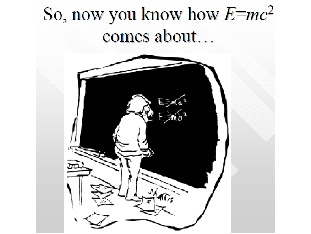 Figure 2: A comic that makes fun of the equation E = mc2. The appearance of the humour in a typically boring physics lecture note adds a pinch of human touch to the learning process.
Figure 2 is a slide from my modern physics ZCT 104 notes, in which I slot in a funny cartoon to poke joke on the famous equation E = mc^2.
 Figure 3: The bibliography of Heisenberg, one of the fathers of quantum mechanics, as appeared in the ZCT 104 lecture material. Students learn some physics history in addition to the uncertainty equation.
Figure 3, also a slide taken from the modern physics lecture note, mention the controversial role played by the physicist Warner Heisenberg during World War II in the Nazi camp. I would usually tell interesting stories and inferences derived from these figures in the lecture hall when they appear on the screen. This story-telling part is what the students like best in during a lecture.
 Figure 4. A suspense-creating question was asked in the beginning of the topic. It would get resolved only towards the end of the lecture after the students realised what time dilation and length contraction, as predicted by special theory of relativity, really meant.
Figure 4 is a “classic” slide from my modern physics course designed to prompt some suspense to the audience, “Can one travels through a distance of 200 light years within one’s life time?” The students would be kept in a suspense mode until the end of the topic when they fully comprehend the idea of time dilation and length contraction as predicted in special theory of relativity.
As I have come to realise it after many years of observation, physics classes are almost inevitably dry, boring and sometimes, scary. In terms of physics analogy, it has unusually high thermal fluctuation that tends to disperse then to coagulate. Personally, my core belief is that physics is not a dry or boring subject. It is intellectually lively, interesting, and relevant to the real world. It is thus always possible to make a physics teaching process fun and interesting, if one bothers to do it. The actual presentation during the real lecture is of course the single most important criterion that determines whether a physics lecture is boring or interesting. On the other hand, quality of the lecture notes also affects quite directly the quality of a lecture in progress. As a matter of personal policy I always try to factor in two important elements. First there must be as much “fun” elements as possible into the lecture materials. Second, the course material should prompt the students to see distinctly the relevance between the theory they learn and the real world they are dwelling in. To achieve such effects, I adopted the strategy as proposed by Tony Buzan, the creator of mind mapping to attract our mind’s attention. According to Buzan, our mind gets attracted most easily to colourful and graphical objects, as well as objects that provide ample space for imagination. To this end, my lecture material are packed with graphics, cartoons, animation, questions that arouse curiosity, comics, physicists’ bibliography, poems, literature quotes, history and philosophy of physics, and other content that is surprisingly unexpected for a physics lecture note. As an example, I would use the movie Lord of the Ring: The Two Towers to illustrate the concept of simultaneity in my special relativistic class. See figure 1.


Figure 2 is a slide from my modern physics ZCT 104 notes, in which I slot in a funny cartoon to poke joke on the famous equation E = mc^2.

Figure 3, also a slide taken from the modern physics lecture note, mention the controversial role played by the physicist Warner Heisenberg during World War II in the Nazi camp. I would usually tell interesting stories and inferences derived from these figures in the lecture hall when they appear on the screen. This story-telling part is what the students like best in during a lecture.

Figure 4 is a “classic” slide from my modern physics course designed to prompt some suspense to the audience, “Can one travels through a distance of 200 light years within one’s life time?” The students would be kept in a suspense mode until the end of the topic when they fully comprehend the idea of time dilation and length contraction as predicted in special theory of relativity.
訂閱:
文章 (Atom)
